Buying guide
Choosing the right range cooker doesn’t have to be complicated. With so many options—widths, fuel types, oven configurations, features, colours, and trims - it’s easy to feel unsure where to start.
This guide is designed to simplify the process. By breaking down the key decisions - from fuel type to oven layout and essential features - you can quickly narrow down the options and find the range cooker that fits your kitchen, cooking style, and budget.
If you’d prefer a more tailored recommendation, our team is here to help. Call us on 01244 402975 and we’ll guide you to the right choice, based on your specific needs and preferences.

Choosing the Right Range Cooker Width
Choosing the right width is one of the most important decisions when picking a range cooker.
Most range cookers come in standard nominal widths of 90cm, 100cm, and 110cm, which are the most common options for UK kitchens. Larger models are also available, with some premium manufacturers - such as Lacanche - offering cookers up to 220cm wide.
How do you choose the right width?
If you’re replacing an existing cooker, your available space will usually guide your decision. In most cases, you’ll want to choose a model that matches the width of your current appliance to ensure a straightforward fit.
If you’re designing a new kitchen or reworking your layout, you have a bit more flexibility. This gives you the opportunity to choose a width that not only meets your cooking needs but also complements the overall look and feel of your space.
An important note ...
One thing that often catches people out is that range cookers are typically slightly narrower than their stated size. This is intentional and makes installation easier. For example, a model listed as 90cm wide might actually measure around 89.6cm, leaving a small gap on either side so it can slot neatly into place without any adjustments.
Range Cooker Fuel Types
Choosing the right fuel type is just as important as choosing the size of your range cooker. Your decision will often come down to a mix of practicality and preference - things like available utilities, cooking style, efficiency, and even the look you want in your kitchen.
All electric range cookers
If you don’t have access to gas, or simply prefer a more modern approach, an all-electric range can be an excellent choice. Most models now feature induction hobs, which are fast, efficient, and widely considered as the more environmentally friendly option.
Induction works by heating the pan directly rather than the surrounding air, which means less wasted energy and quicker cooking. As electricity generation increasingly shifts towards renewable sources, this can also make induction a more sustainable long-term choice.
One thing to keep in mind is that electric ranges require a suitable power supply. In many cases, this means a dedicated cooker circuit, typically around 45 amps, although some models may require up to 60 amps. A few brands, such as Stoves and Belling, offer induction models that can run on a standard 32-amp connection. It’s always worth confirming the exact requirements for your chosen model and speaking to a qualified electrician if you’re unsure.
Induction cooking has grown rapidly in popularity and is now starting to eclipse dual fuel as the go-to option for many households.
Dual fuel range cookers
Dual fuel models combine the best of both worlds: a gas hob for responsive, hands-on cooking, and electric ovens for consistent, even heat.
You’ll need both a gas supply (either mains or LPG) and an electrical connection suitable for the oven. Most dual fuel ranges are set up for mains gas as standard but can usually be converted to LPG using a set of gas jets, which are often included or available from the manufacturer.
Gas range cookers
Despite fewer manufacturers producing all-gas ranges, many people still prefer cooing with gas as they have grown used to the moister results of a gas oven. Alternatively, a high-current electric circuit may not be available, and a gas cooker is an ideal solution. You will still need an electricity supply to run the timer, ignition and lights, but this will usually be via a 13Amp plug rather than a dedicated cooker circuit.
It’s important to note that all-gas cookers are usually built for a specific type of gas and are not typically convertible. Using the wrong gas type can be dangerous, so it’s essential to seek advice from a qualified Gas Safe (formerly CORGI) engineer before installation.
Gas supply types
Most homes in the UK are connected to natural (mains) gas. However, properties in more rural areas often rely on LPG (liquefied petroleum gas), supplied via tanks or bottled gas such as propane or butane. In places like the Channel Islands, piped gas may still be LPG-based, mixed with air.
LPG ranges
Demand for fully LPG-powered range cookers is relatively low, so fewer models are available than in the past. Rangemaster remains one of the main brands offering LPG-compatible options, along with a small number of other manufacturers.
Induction Technology
Induction technology has been used in professional kitchens for over 40 years, but is still relatively new in the home. It first appeared in range cookers in 2007, when Stoves introduced their Sterling 1100E model.
For many people, induction can feel unfamiliar at first—but once you’ve used it, it quickly becomes second nature. In fact, many new users wonder why they didn’t switch sooner.
How does induction work?
Beneath the glass surface of the hob sits a powerful electro-magnet. When a suitable pan is placed on top, this magnet interacts directly with the metal in the pan, generating heat within the pan itself rather than on the hob surface.
Because this process is controlled electronically, any adjustment you make is almost instant—giving you a level of control that’s very similar to gas, but often faster.
Why choose induction?
Induction has become increasingly popular for a few simple reasons:
- Fast and responsive
It heats up incredibly quickly—water can begin to boil in seconds—and cools down just as fast. There’s very little residual heat, so switching from boiling to simmering is immediate. Many models also include helpful features like Auto Heat-Up and Power Boost for extra flexibility. - Even, consistent cooking
Heat is distributed evenly across the base of the pan, reducing hot spots and making it easier to cook delicate foods like sauces or jams without constant stirring. - Energy efficient
Because induction heats the pan directly, very little energy is wasted. It’s typically around 25% more efficient than ceramic hobs and around 30% more efficient than gas.
Controls and features
Most induction range cookers are still operated using traditional rotary controls, although some models include touch controls and digital displays. Because the surface itself doesn’t get as hot as other hob types, controls can sometimes be integrated directly into the glass.
Many models also include practical features such as timers, pause and recall functions, automatic switch-off, keep-warm settings, and bridging zones for larger pans or griddles. It’s worth checking the specification of your chosen model to see exactly what’s included.
Safety and cleaning
Induction is widely regarded as one of the safest cooking methods. The hob surface only heats up from contact with the pan, and usually only in that specific area. Residual heat indicators will let you know if the surface is still warm.
Additional safety features often include child locks, automatic shut-off, and sensors that detect when a pan has boiled dry.
Cleaning is also straightforward. The smooth glass surface can simply be wiped down, and because spills don’t tend to burn on, maintenance is minimal.
Will you need new pans?
Induction hobs require cookware made from, or containing, a ferrous (magnetic) material. Many modern pans are already induction-compatible, and you can usually check by looking for a label such as “Suitable for Induction”.
As a quick guide:
Works well - cast iron, enamelled steel, and many induction-ready stainless steel or aluminium pans
May not work - standard stainless steel (unless designed for induction)
Not compatible - glass, ceramic, copper, or aluminium pans without a magnetic base
If you’re unsure, a simple test is to see if a magnet sticks to the base of the pan.
Electric Ovens
Electric ovens offer a great deal of flexibility, which is why they feature in the majority of modern range cookers. Depending on the model, you may find a combination of conventional, fan, and multifunction ovens - each suited to slightly different styles of cooking.
Pre-heating
One of the main advantages of electric ovens is how quickly they heat up, especially when compared to gas. Fan ovens are particularly efficient, often reaching temperature in 3–4 minutes, while conventional ovens (gas or electric) can take 10–15 minutes.
Allowing the oven to fully preheat is important for consistent results, particularly when cooking chilled or frozen foods.
Conventional electric ovens
A conventional oven uses heating elements—typically at the top and bottom—to create natural heat circulation. This results in different temperature zones within the oven, with hotter air at the top and cooler air towards the bottom.
This makes them ideal for traditional cooking. For example, you might place meat on the middle shelf, potatoes higher up, and desserts lower down to make the most of the varying temperatures.
Slow cooking
Slow cook ovens are designed for low-temperature, long-duration cooking—perfect for stews, casseroles, and dishes that benefit from gentle heat over time. They’re also very convenient, as many recipes require minimal preparation before leaving to cook.
Some range cookers include a dedicated slow cook oven, often a smaller cavity, while others offer a slow cook setting within a standard oven. In addition to cooking, these compartments can also be useful for warming plates.
Fan ovens
Most range cookers include at least one fan oven, and for many people, it becomes the most-used cavity.
A fan oven circulates heat evenly throughout the oven, making it ideal for batch baking or cooking multiple dishes at once. Because the heat is more consistent, you can often cook at a slightly lower temperature than recipes suggest, while still achieving excellent results.
Fan ovens also tend to heat up quickly and use energy efficiently.
Common fan oven functions may include:
- Fan cooking: even heat throughout the oven for general use and baking.
- Defrost: circulates air without heat to gently thaw food.
- Fan-assisted grilling: distributes heat from the grill element for more even cooking, without needing to turn food.
Multifunction ovens
Multifunction ovens take flexibility a step further by allowing you to choose from a range of cooking modes, depending on what you’re preparing.
While functions vary by model, common options include:
- Conventional cooking: ideal for traditional roasting using natural heat zones
- Top heat only: useful for gentle browning or finishing dishes like lasagne or gratins
- Bottom heat only: helps crisp bases on pizzas, pies, and quiches
- Base heat with fan: combines a cooked base with gentle, even heat for fillings
- Fan-assisted cooking: well suited to foods with higher moisture content, such as meats and fish
- True fan cooking: provides very even heat, ideal for baking
- Rapid preheat functions: reduce waiting time by bringing the oven up to temperature quickly
- Grilling options: both traditional and fan-assisted modes for different results
There’s also usually a simple oven light mode, which can be handy for checking progress or cleaning.
Gas Ovens
Gas ovens use natural heat circulation to distribute warmth throughout the oven cavity. This creates distinct temperature zones, with hotter air towards the top and cooler temperatures at the bottom.
While gas ovens are generally slower to preheat than fan or multifunction electric ovens, they remain a popular choice. Many people simply prefer the familiarity of cooking with gas, while others value the slightly moister cooking environment, which can be particularly beneficial for baking.
These natural temperature variations also make gas ovens well suited to traditional cooking. For example, you can roast meat on the middle shelf, cook potatoes higher up where it’s hotter, and place puddings lower down where the heat is gentler.
Oven Features
Alongside ovens and fuel types, many range cookers include practical oven features designed to make everyday cooking easier, safer, and more enjoyable.
Telescopic shelves
Telescopic shelves are a particularly useful addition, available as standard on some brands (such as Stoves and Mercury) and as an optional extra on others.
They run on smooth steel runners, allowing the shelf to glide out like a drawer. This means you can check, baste, or remove food without reaching into a hot oven, reducing the risk of spills or burns.
Although the runners are fixed at specific heights, the shelves can usually be removed for cleaning or repositioned as needed.
Rangemaster Handyrack
Found on Rangemaster cookers, the Handyrack is a simple but clever feature.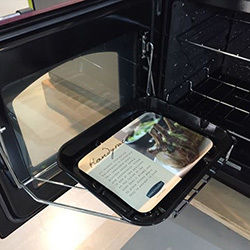
It’s a removable shelf attached to the oven door, which swings out as you open it. This brings your roasting tray forward automatically, making it much easier to check and baste food—without having to lift heavy dishes in and out of a hot oven.
The Handyrack can be positioned at different heights depending on what else you’re cooking, allowing you to make full use of the oven space.
For safety, it’s designed to hold a maximum weight of 5.5 kg (12 lb) and should be used with the supplied tray to ensure stability.
Plate racks
Serving food on warm plates can make a noticeable difference, especially during longer meals.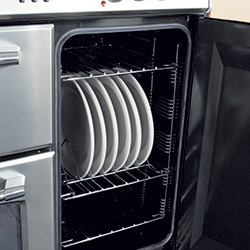
Many range cookers with a tall oven—particularly from brands like Rangemaster and Stoves—include a built-in plate rack. This allows you to stack plates safely and warm them through before serving, helping food stay hotter for longer.
Rotisseries
A rotisserie is a great option if you enjoy cooking meats like chicken, pork, or duck.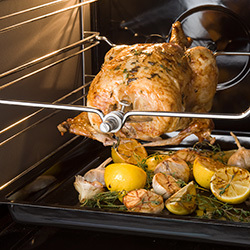
The rotating spit allows the meat to cook evenly in its own juices, helping it stay tender and full of flavour. Because it uses the grill element, there’s also less fat splatter, which can help keep the oven cleaner.
The motor is usually built discreetly into the oven, automatically turning the spit for consistent results.
Oven Linings
Keeping your oven clean doesn’t have to be a chore, and many range cookers now include features designed to make maintenance easier. The type of oven lining you choose can make a noticeable difference to how much effort is involved.
Standard enamel
Traditional enamel is still widely used and remains a practical, cost-effective option. It’s smooth and easy to wipe down, although it does rely a little more on regular upkeep.
The simplest way to keep on top of it is to adopt a “clean as you go” approach. Wiping away splashes early - and even placing a baking tray at the bottom of the oven to catch drips - can prevent build-up.
If marks do occur, allow the oven to cool before cleaning with a damp cloth and a mild detergent. Stubborn residue can usually be removed with a gentle cream cleaner or a soap-impregnated pad, taking care not to damage the surface.
Easy-clean enamel
Some manufacturers offer enhanced enamel finishes designed to make cleaning even easier. These finishes have a harder, smoother surface, which makes it more difficult for grease and food residue to stick. As a result, most marks can be wiped away with minimal effort.
Testing has shown that easy-clean enamel can be up to three times easier to clean than standard enamel, thanks to its more compact structure, which reduces absorption. It also has the added benefit of antibacterial properties.
In day-to-day use, cleaning is much the same as standard enamel - warm water, mild detergent, and occasional use of a gentle cleaner for tougher marks.
Catalytic oven liners
Often referred to as self-cleaning, stay-clean, or cook & clean liners, catalytic panels are a popular feature on many range cookers.
They’re usually easy to spot by their textured, matte surface and are typically fitted to the sides and back of the oven (and sometimes the roof).
How they work:
Catalytic liners are coated with a micro-porous material that absorbs grease and breaks it down during cooking. They work most effectively at temperatures above 200°C, so after roasting, it can help to leave the oven at a high temperature for a short time to allow the cleaning process to complete.
Maintenance:
While they reduce the need for manual cleaning, they don’t eliminate it entirely. If heavy splashes occur, you can wipe them away once the oven has cooled. Occasionally, the panels may need to be removed and washed in warm soapy water, then dried and reheated to restore their effectiveness.
To avoid damage, it’s important not to use abrasive cleaners, steel wool, or harsh chemicals on catalytic liners.
Pyrolytic ovens
At the top end of the scale, pyrolytic cleaning offers a near hands-off solution.
When activated, the oven heats to a very high temperature, turning food residue into a fine ash. Once the cycle is complete and the oven has cooled, you simply wipe away the remaining ash.
This is one of the most effective cleaning methods available, although it’s still relatively uncommon on range cookers and tends to be found on more premium models.